



Your agent has been compromised. Now what?
Enterprises don’t want to hear it, but their AI agents are going to be compromised. Agents keep getting more autonomous, supply-chain attacks keep scaling, and agents ingest an enormous volume of untrusted data. Put those together and compromise stops being a question of if. It’s a question of when.
AI agent incident response is the work of containing and investigating a compromised autonomous agent: revoking its access, stopping the sessions and subagents it spawned, and reconstructing what it touched and on whose authority. The hard part is that an agent moves at machine speed and delegates to other agents, so containment has to reach the whole chain, not just the one agent you noticed.
So here you are. You installed an npm package with a malicious postinstall script. That script uses your coding agent to spawn 50 subagents that comb your filesystem for every password, API key, and trade secret you left lying around. Then it scans your network for other agents it can collaborate with. By the time you reach incident response, you don’t know how far it spread, which secrets it got, who it sent them to, or what to do next.
At that point you have two options:
- Revoke every credential that might be compromised, take the whole network offline, and go machine by machine resetting everything back to the last backup.
- Go back in time to before the incident and set up Highflame’s Agent Control Fabric.
Highflame Agent Control Fabric
Agent Control Fabric is Highflame’s three-layer governance solution for securing enterprise agents end to end.
- Agent Identity gives every agent its own scoped credentials, which is what makes delegation and attribution possible.
- Agent Authorization checks every action an agent takes against a least-privilege policy tuned to what that agent is actually there to do.
- Breakout Controls keep an agent doing what it’s supposed to do, not just what it’s authorized to do.
Identity means every action an agent takes, every subagent it spawns, and any other agent it pulls into its scheme are cryptographically linked and recorded. When something goes wrong, the chain of compromise is already captured: every action taken, every resource accessed, every agent that acted on behalf of the compromised parent. Authorization stops your coding agent from touching sensitive files that are off limits and holds it to commands inside its mission scope. Breakout controls screen the traffic between agents for prompt injection and tool poisoning, the moves one agent would use to turn another into an accomplice. Together that’s defense in depth: it prevents compromise where it can, contains it where it can’t, and leaves an audit trail so every incident becomes something you learn from.
When an agent is compromised, the first job is to limit the blast radius. Highflame Identity lets you revoke an agent’s credentials instantly, rendering it inert along with every infected session down the chain. One click halts every session along the chain of compromise. You revoke agent credentials, not the shared service keys other applications depend on, so containment is a scalpel instead of a sledgehammer.
Highflame Identity: revocation that cascades
Here is what containment actually looks like in a multi-agent system running on Highflame Identity.
The scenario. Seven long-running agents across three tiers. An orchestrator at the root holds every privilege scope. Below it sit two managers, one for research and one for operations, each with a strict subset. Below them, four specialist tool-agents each take a subset of their manager’s scopes.
orchestrator                  all scopes              ← root of trust
├── manager-research          research + web:read
│   ├── sub-research-lit      research:read · web:read
│   └── sub-research-syn      research:read · research:write
└── manager-ops               ops + deploy:write
    ├── sub-ops-mon           ops:read
    └── sub-ops-deploy        ops:read · deploy:write
Two things are worth noticing before anything gets revoked.
Every credential below the root was minted by delegation, not handed out. The orchestrator was seeded once. Everything beneath it was issued by exchange: a child proves who it is, its parent attests to it, and the platform issues a new credential that records which credential it descended from. That parent-child link, stored server-side for every credential, is the entire delegation graph.
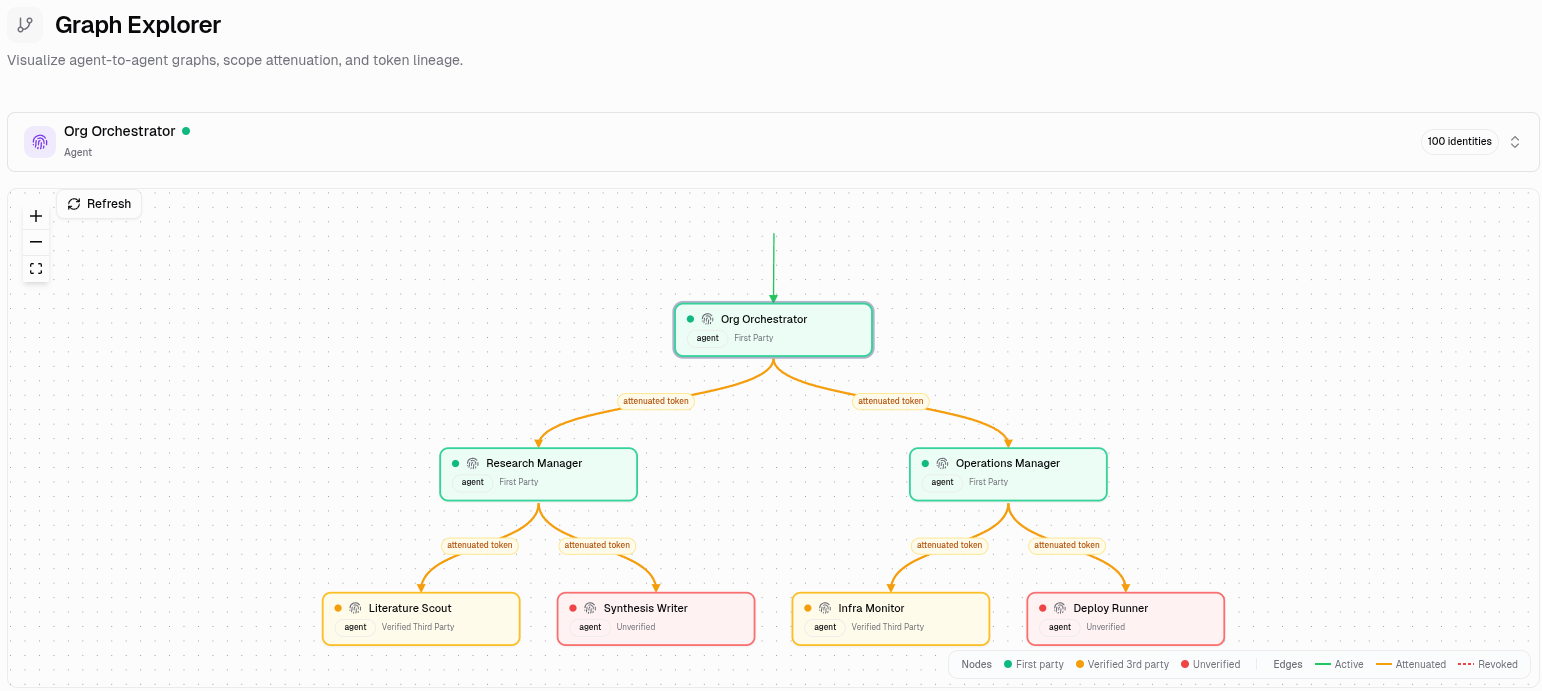
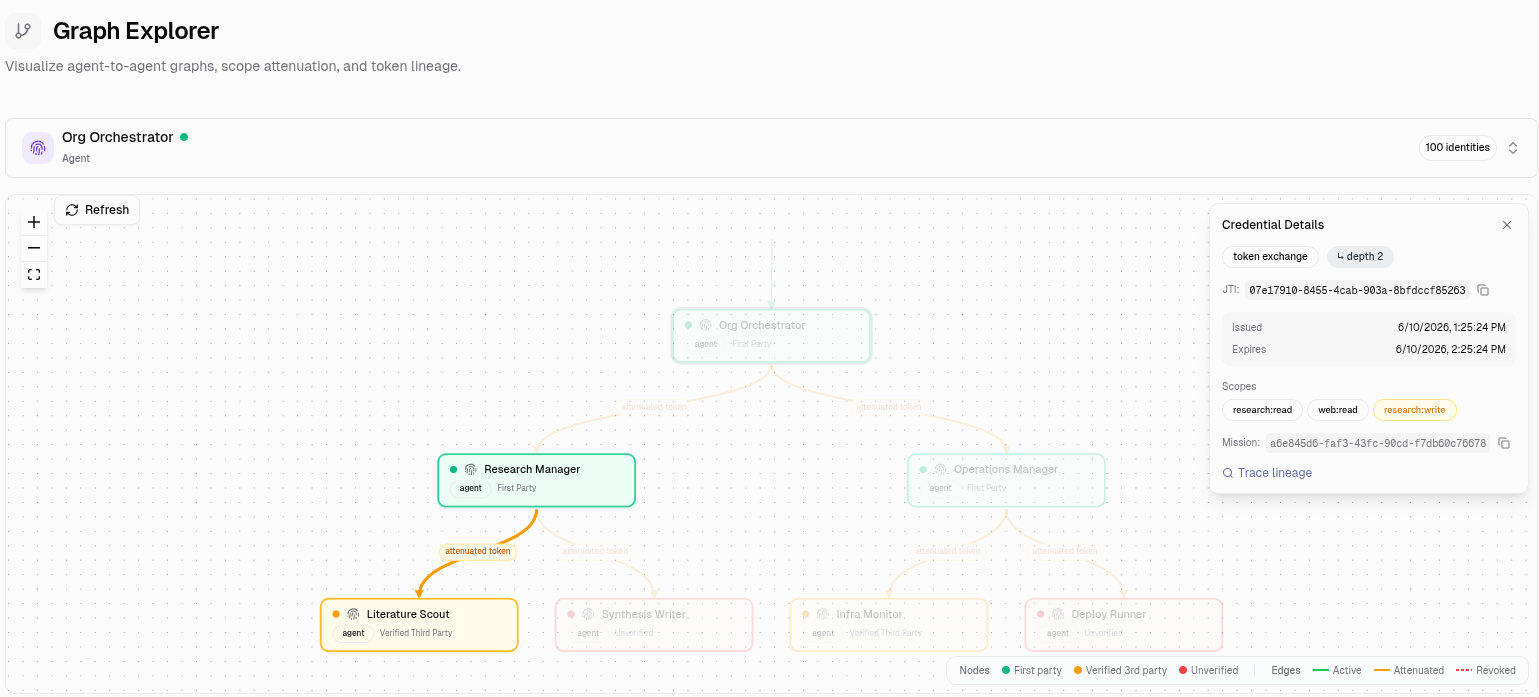
Authority only ever shrinks on the way down. A child can never hold a scope its parent didn’t have. In the Highflame dashboard you can view the relationships, delegations, and attenuations directly. Every edge in the graph renders this attenuation, so you can watch authority funnel from all scopes at the root down to research:read, web:read at a leaf. Nothing in the tree is over-privileged relative to the agent that delegated to it.
Why ordinary revocation breaks at the second hop
Revoking a credential one level deep is easy. You invalidate it, one agent stops working, done.
The trouble starts at the second hop. The credential a specialist holds doesn’t point at the root. It points at the manager’s credential that produced it. So if you revoke the root, nothing happens to the specialist, because the specialist’s credential was never the root’s to begin with. And if you revoke the manager, the specialist is only affected if something on the server remembers that the specialist’s credential was derived from the manager’s, and acts on it.
Most token systems don’t remember. They mint a credential, store a hash so they can revoke that one, and stop there. Children are separate, independently issued credentials with their own clocks. If a compromised parent spawned a swarm of compromised subagents, revoking the parent does nothing to stop the spread.
That gap is the whole problem. If your credentials live for an hour, a compromised manager can hold its specialists open for up to an hour after you’ve “revoked” it. Your exposure window isn’t just your time-to-detect; it’s your time-to-detect plus the full lifetime of every credential downstream.
What containment looks like instead
Highflame Identity treats the parent-child links as a graph it can walk, not metadata it forgets.
When a credential is revoked, whether an operator pulled it or a security signal fired against the agent holding it, the platform doesn’t just flip that one credential off. It walks the graph from that node and invalidates everything that descended from it, in a single atomic step. There’s no waiting for expiry, because expiry was never the mechanism. The next time any downstream agent checks its credential, the answer is already invalid.
The moment of revocation
Now revoke manager-research, the research branch’s manager, and treat it as the compromised node.
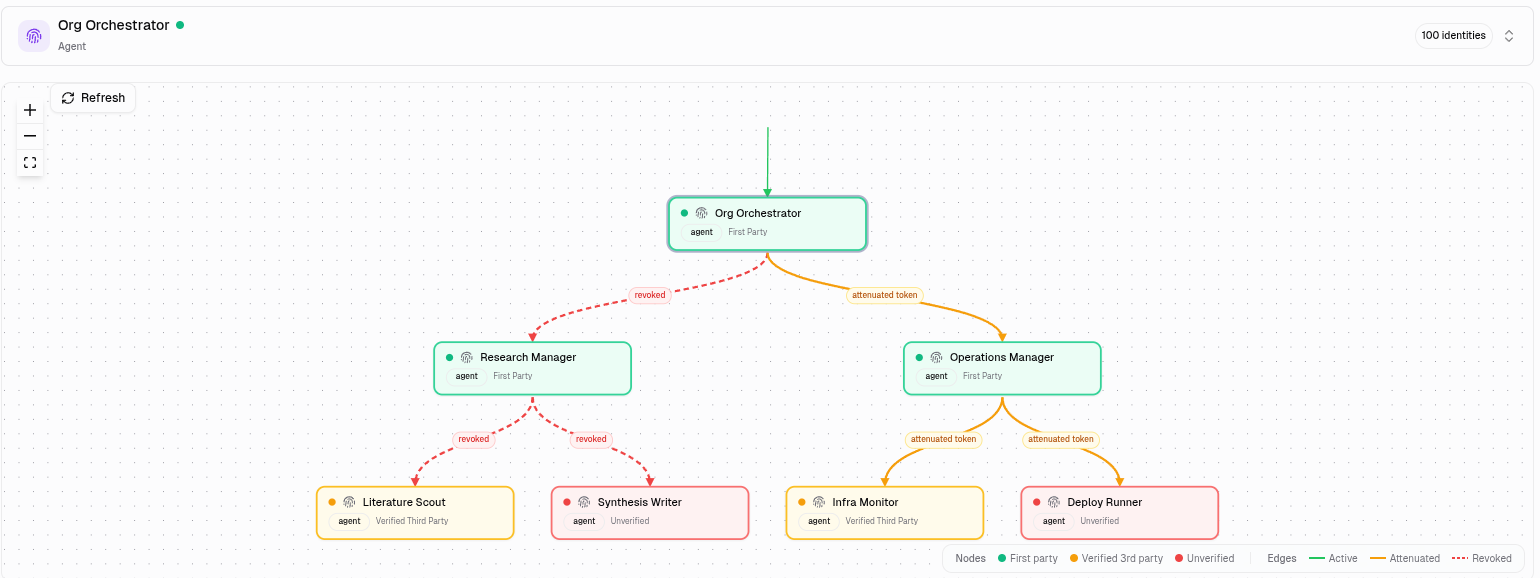
Three credentials die from one action:
| Agent | State after revoking manager-research |
|---|---|
manager-research | revoked, the node you targeted |
sub-research-lit | revoked, descended from it |
sub-research-syn | revoked, descended from it |
Because the specialists revalidate on every request, they don’t stay alive until their tokens expire. The next check comes back invalid, and the work they were doing for the compromised manager stops there.
See it yourself
Highflame Identity is open source. You can find it at github.com/highflame-ai/zeroid. The delegation tree, the attenuating scopes on every edge, and the cascade you just watched are all real, issued through standard delegation, revoked through standard revocation, and rendered live in the Highflame dashboard’s delegation graph.
If you’re building multi-agent systems, read more about Highflame’s Agent Control Fabric, book a demo, or start a free trial.
Frequently asked questions
What is AI agent incident response?
The process of containing and investigating a compromised autonomous agent: cutting its access, stopping the sessions and subagents it spawned, and reconstructing what it did and on whose authority.
How do you contain a compromised AI agent?
Revoke its identity so every session and subagent that descended from it fails its next check. With scoped per-agent credentials you can do this without touching the shared service keys other applications depend on.
How is this different from responding to a normal breach?
An agent acts at machine speed and delegates to other agents, so the blast radius grows in seconds and spreads down a chain. Containment has to reach the whole delegation tree, not just the one process you noticed.
Can you revoke one agent without taking down shared services?
Yes, if each agent has its own scoped credential rather than a shared key. Highflame revokes the compromised agent’s credentials and the chain beneath it, leaving the service accounts other apps rely on intact.